
|
 |
 |
 |
 |
 |
 |
 |
 |
 |
 |
 |
||||
| Archives:News & Events(Regional) |
|
|||
|
||||
|
PARUMALA PILGRIMAGE : AN UNFORGETTABLE EVENT FOR MUMBAI DIOCESE
|
|
The Pilgrimage from Mumbai to Parumala, arranged under auspices of Bombay Diocese of Malankara Orthodox Church has turned out to be the most memorable and epoch making event written in Golden letters in the history of the Orthodox Christians of Mumbai and neighboring places. During the Centenary Celebrations of the Singled out Declared Saint of Orthodox Church, St.Geevarghese Mar Gregorios of Parumala, around 900 Pilgrims under the leadership of H.G.Geevarghese Mar Coorilos from different places of Maharashtra, Gujarat, Goa, Bahrain, Doha, Saudi Arabia etc. traveled 1500 miles to pay homage and to take refuge of the Intercessions of the Saint. |

|
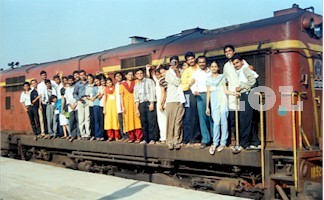
MGOCSM MEMBERS OUTSIDE TRAIN |
|
As per the statement of the Convener of the Pilgrimage, Mr.P.J.Chandy, this is the first time in the history that a special full train was chartered from Mumabi for a Pilgrimage to South India. Parumala Thirumeni very much aspired to build a Church in Bombay City, which is known as the Gateway city of India. This ardent wish of the Saint was recorded in the Journey Report of Thirumeni's Pilgrimage to Holy Land, Jerusalem. As a consummation of his desire, Bombay diocese of Orthodox Church came into existence for all the neighboring provinces of Maharashtra, Goa, Gujarat and Gulf Countries. Not only many Churches were established in the Mumbai City, there exist a Church know as 'Parumala of Mumbai' . With all these connections of Bombay with the Saint, Mumbaites consider it as big blessing that they could organize a Pilgrimage from Bombay to Parumala in such a massive way. The inspiration for such gigantic pilgrimage was received from the sincere wishes of Mumbaites to give guidance to the socially and morally deteriorating generation. In a bid to control the proliferation of the younger generation in this age of pervasive and penetrating materialistic influences and Alcohol and drug abuse being major social evil of the time, this type of Pilgrimages with the spirit of fasting and prayer be a major step towards the spiritual rejuvenation. |

|
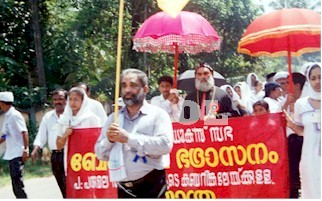
PADAYATHRA TO THE TOMB |
|
The Bombay Diocese of Malankara Orthodox Church was formed in 1976. H.G.Dr.Thomas Mar Makarios was the first Bishop (1976-1979) of the Diocese. H.G.Dr.Philipos Mar Theophilus lead diocese from 1979-1997. The current Diocesan Metropolitan is H.G.Geevarghese Mar Coorilose. Head Quarters of the Diocese is at Orthodox Church Center New Bombay. This massive Pilgrimage during the Centenary was organized under the leadership of the current Diocesan Bishop Geevarghese Mar Coorilos. There are 52 Churches, 13Chapels in the Diocese. 42 Priests are serving the parishes spread over Maharashtra, Gujarat, Goa and few Gulf Countries |

|
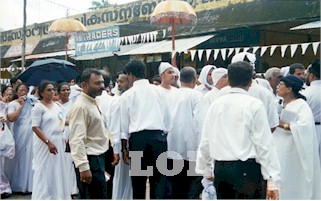
A VIEW OF THE FAITHFUL PILGRIMS |
|
At the turn of the 20th century, a Holy man lived in a haunted island, called Parumala, on the banks of Rivers Pampa and Achencovil in Kerala, India under strict observance of ascetic rigors in the foot steps of St. Antony and had gained divine powers. He was the prophet of his time, who set moral tone for the believing community. Experiences of healing the sick, casting off devils, reconciling bitter feuds, etc. are known to many even today. This year was a special year for the memory of St.Gregorios as 100 Years had passed after he left for heavenly abode. This year thousands and thousands of Pilgrims reached Parumala Church, where the holy relics of the Saint Parumala Thirumeni is interred, walking all the way. The faithful pilgrims went to Parumala from different parts of the country as well as overseas. Powerful like Prophet Elijah and glittering like John the Baptist, he remains the beacon and a great Saint of the Malankara Orthodox Church. Innumerous number of believers in India and outside remember, find refuge in the intercession and venerate this saint. Veneration begins with pilgrimage — pilgrimage to the holy place where the saint lived — pilgrimage to the place where God has answered prayer. Orthodox Church believers are currently experiencing a great revival in such pilgrimages to the Tomb of St.Gregorios. |

|
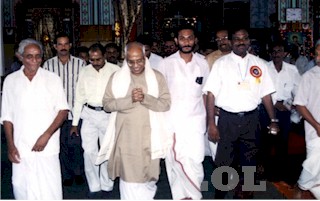
MINISTER RAJAGOPAL DURING RECPTION AT PUTHIAKAVU |
|
A pilgrimage is travel to sites sacred to a particular religious or spiritual tradition for the purpose of renewing or revitalizing one's connection with that tradition. In ever-greater numbers, people are drawn toward spiritual travel, with a hunger for blessings that unveil journeys of the soul--footsteps that are meaningful and mindful, intimate and catalytic. Adventures of the Spirit embraces these rich possibilities within travel, showing us the many faces of pilgrimage: traditional and unconventional, religious and secular, intended and accidental. What is a pilgrimage? Far more than just a sight-seeing expedition, a pilgrimage is, for the Christian, a reflection of life, a small symbol of the great pilgrimage that is life; a journey home, home to our eternal reward. To embark on a pilgrimage is to embark on a period of intense spiritual growth. It requires preparation, repentance, and a real desire for amendment of life and indeed to become open to God's will. It requires a journey, if you like, as a symbol of the effort that is indispensable for spiritual growth. And finally, it requires a place, usually a place associated with a particular saint where we can concentrate on another's spiritual journey as an aid to our own. At that place we will pray, we will look, listen, touch, smell, and be. Often we may take a problem with us and often we go to be healed — physically, mentally, and spiritually. If we are open to God and listen, we shall return from our pilgrimage greatly enriched, and often in a way that we had never dreamed. Lastly, pilgrimages are a time to be in the presence of other Christians, to bind with love of fraternity, understanding and inter-suffering. Basic intention of observing the feasts of the Saints must be to follow and imitate the lifestyle of those saints. |
| Back | Home | Top | ||||||
 Email this Link to a
Friend Email this Link to a
Friend
|
 Send Your Feedback Send Your Feedback
|
|
|
|
St. Gregorios Orthodox Syrian Church of India in Oak Park, Illinois has sponsored an inter-faith seminar on November 23, 2002 in memory of the late Metropolitan Dr. Paulos Mar Gregorios. The topic of the Seminar was "Pluralism, Unity, and the World."
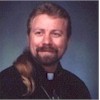
Rev. Fr. John-Brian Paprock gave an insightful and scholarly presentation, "Embracing All Humanity: The Vision of Paulos Mar Gregorios in the 21st Century". Swami Varadananda (Vivekananda Vedanta Society, Chicago) talked on "A Hindu Perspective of Pluralism and Unity". Dr. Javeed Akhtar, MD, Executive Director of ISPI (an Islamic Think-Tank) gave a Muslim perspective based on the teachings of the Holy Quoran. Mr. Rajinder Singh Mago, an active member of the Parliament of World's Religions spoke on the Sikh Perspective on Pluralism and Unity. Dr. Joseph Thomas led the Panel discussion. |
|
|
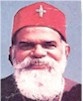
Late Dr.Paulose Mar Gregorios was an eminent Philosopher, well known scholar and Champion of Peace and Justice of our contemporary society. He was one of the religious personality from India to become a stature of Indian Christian Spokesman of the world through his relentless participation in an international peace movement. He was also intuitive analyst and peace lover who campaigned to get-rid of Nuclear weapons from the world. His anti-nuclear enthusiasm bagged the title for him 'The Red Bishop' among the western media.
Gregorios was born on August 9, 1922 at Tripunithura, to T.P. Paiely and Aley. Young Paul was a very brilliant student and a gifted orator. Paul Varghese started his career as a freelance journalist. The turning point in his life was with his appointment as a teacher in Ethiopia. He knew this was the answer to his prayers. As a teacher in Ethiopia, he imbibed the rich culture of the Ethiopian people, mastering Amharic their ancient and official language. The Ethiopian Emperor, H.H. Haile Sellassi, learned about his capabilities and enthusiasm and soon took him as an intellectual aide in his court. He was send to USA and received his education from Goshen College, Oklahoma University, Princeton and Yale. In 1954, he returned to India with a Masters Degree in Theology. He worked a Director of the Fellowship house in Alwaye and a visiting Professor of Union Christian College, Alwaye. In 1955, he joined the faculty of The Orthodox Theological Seminary, Kottayam. In 1958, he was ordained as Deacon and in 1961 he was ordained as Fr. Paul Varghese.
He did his Doctoral studies in Oxford and Germany and received his Doctorate in Theology from Serampore University in Calcutta. His enlightened views of Union of God and humanity made him to be the President of World Council of Churches(1983-1991). He served as Associate General Secretary, Member of Central and Executive Committee and Member of Commission of Faith and Order. He was an outstanding and renowned theologian, a stimulative thinker and powerful author.
Dr. Paulose Mar Gregorios lived a life of firm commitment to service of society and for a life in pursuit of excellence. He left for his heavenly abode on November 24, 1996. |
|
Respected and distinguished guests, friends of different faiths and
traditions, |
|
I am honored and humbled by this opportunity to address you on this
occasion, in this place.
This is a wondrous occasion of diverse representation of religious
traditions in Wisconsin. Although interfaith gatherings have become
more common, especially since 9-11, this is the 5th Interfaith
Awareness Week. In 1998, Wisconsin's proclamation of an Interfaith
Awareness Week (that I called Religious Diversity Week in the
proclamation's initial draft) was the first in the nation. Others
have followed this example in their own localities with various
levels of success.
With all this wonder and positive regard for those that believe
differently, let us not lose track of the significant issues
presented by interfaith activity, of living in a free society where
individuals can live out their religious faith as they choose. We
cannot ignore that the conflicts of absolute understanding in
religious traditions have ravaged the world in the past and threaten
the world today.
Interfaith service, education, leadership, ministry is "between
faiths." It is the backyard fence where neighbors meet in small
communities across our state. It is not the dinner table, despite
appearances that may suggest otherwise.
One thing I appreciate about interfaith work is that it is "between"
faiths (lit: inter- between). It is not meant to integrate or create
new religions. It is simply dialogue and working with those that
have a different faith and believe differently. Rev. Dr. Martin
Marty of the Public Religion Project, himself a Lutheran pastor,
said that only a small percentage of people are converted by
interfaith activities. The majority, he reported in 2000, find their
own faith in their own tradition deepened as a result. (I think he
said 85%) Indeed, this has been my experience. My faith has only
deepened in experience and _expression. People of different faith
traditions can come together for a variety of reasons, but they
cannot come together in peace with dreams of domination or
conversion of others.
Having contemplated interfaith issues for many years, I am convinced
that any response to the problems presented by interfaith activity
must begin with my internal atmosphere, my religion, my
spirituality - each one of us according to their conscience. Then,
the outward response to the community and the world as a whole will
be effective. Ethical and moral behavior has a basis in our
beliefs.
There are three things that I believe can improve relations between
those that believe differently:
1. Follow our own traditions. There may be novelty in another's
religious tradition or cultural _expression, but we must be clear of
the path we follow. It is only by being a "good" Christian or good
Buddhist or good Muslim or good Hindu or good "whatever" as we may
be that we can find inner peace; that we can find congruency between
the inner life and outer life to influence the world around us.
Peace in the world begins with peace within each of us. But this is
only where it begins...
2. We need to develop greater interactive vocabularies so that we
can discuss our spiritual insights with each other without getting
caught up in rhetoric. Then we can avoid getting misled by those
that would use their religion to further personal agendas.
3. We need to be allowed to struggle with our personal issues
related to diversity openly. How do we feel about those that believe
differently?
In my tradition, we are taught to love all people, including our
enemies. We are taught to be agents of peace in distress and light
in darkness. As we have been given freely, so we give. There are
those, we believe, that can exclude themselves by their free will.
But their fate is between them and God; our interactions with them
must be without judgment, as our neighbors. We are taught that love
and free will are so intricately connected that we cannot suppress
another's free will and still demonstrate love. Indeed, we cannot be
instruments of peace if we cannot love others as ourselves, allowing
others freedom to worship and belief that may be very strange to us.
There is no compulsive reaction that requires us to believe as they
do just because we love them enough to allow for divergent beliefs
and choices.
One question I have pondered in coordinating interfaith
activities, "How do you include an exclusivist?" So often we feel
our safety depends on homogeny rather than in a supreme beneficent
entity that may have greater plans than any of us on our own can
comprehend.
It makes sense that if everyone believed the same thing, there would
be a peace - of sorts, but we know from our common experience in
modern society that it is extremely unlikely that peace will come in
this manner. There are those that are threatened by the free
exchange of ideas and use this neighbor fence-line where interfaith
gatherings meet as a scapegoat. I have met those also that are still
searching and those that are full of their over-riding theology -
both exclusivists and relativitists as well as atheists - who, in
one way or another, distort the reality of diversity to meet their
agendas. Some of these have the best of intentions.
Knowing that we can't seem to rid of differences, I have taken up
the "celebration of diversity" approach. Homogeny may seem like a
paradise to most, but it is only a panacea. The reality is there is
no indication that homogeny will happen and all the violence
and "ethnic cleansing" that we have endured in this world over the
centuries hasn't moved it any closer.
I believe that the future will have to deal with honoring tremendous
diversity in a peaceful manner and, yet, having a standard of moral
and ethical conduct that is acceptable to all. Pointing fingers at
those that we can easily see are in conflict does little to resolve
the conflict and only facilitates a means to feel superior - which
then mostly likely creates greater conflict rather than movement
toward peace.
"Everyone is entitled to his own faith. No one should violate the
intimate, spiritual life of another. That's how I think now, that's
how I have thought in the past, and if I live any longer, that's how
I'll think then," said Bulgarian Orthodox Bishop Boris Kharalampiev
who, as a priest, helped stop the deportation of the Jewish citizens
of his city in 1943.
In Orthodox Christianity, there is an acceptance of "mystery." There
is mystery and paradox in the belief of created beings with free
will. It is a mystery how a beneficent God in His love can allow
free will choices of His created beings that may be the antithesis
of all that He is - Goodness, holiness, love. Despite the
philosophical and theological implications that are regularly
debated at seminaries and Internet forums, pondering of such
mysteries matters little if we are unable to manifest, even in an
imperfect manner, the attributes of goodness, holiness and love.
It is our ability to allow others' free will that is the gift of
loving them. Not that we have much choice. However, there are those
locally, nationally and internationally, that still try to assert
their will upon others, often justified by quotes from religious
scripture or religious teachers. Gandhi said, "Any assertion of will
upon another is an act of violence." This may be a guiding principle
for gauging the validity of those that are called religious
teachers, regardless of their tradition.
So many groups are working at "willing" a positive future.
Unfortunately, some, if not most of these, have conflicting
outcomes. For instance, large numbers want to have a Christian
future, either where we have realized we are all Christians or only
those that are Christian are left living. Either way the outcome is
the same. Even though I have to admit that I have a utopian mind set
in my views of the future, I need to still deal with the present
reality according the tenets of Orthodox Christianity.
St. Seraphim of Sarov, a 19th Century Russian Orthodox saint and
mystic, once said, "If you find inner peace, a thousand around you
will be saved." Perhaps his words can motivate us to go deeper into
our respective traditions. "We will find benefit for ourselves when
we start seeking benefit for our neighbor." 4th Century St. John
Chrysostom reminds us.
I am fond of looking to the world of the seventh generation
children. What kind of world should they have? I do hope they will
have thousands of different flowers to enjoy and are able to play
with hundreds of different butterflies. Diversity is important and
full of wonder.
I believe that we can have harmony with diversity of belief as a
symphony has harmony with a diversity of musical instrument.
However, harmony can only be achieved if each instrument is tuned
properly.
Religion is for each of us to learn and grow spiritually in humility
and wisdom. Living our lives in the best way to honor our Creator
means accepting the reality that He could have made a homogenous and
subservient people, but instead He allows diversity of organization
and belief.
Once I give up trying to convince everyone of my beliefs and just be
a believer, be a Christian rather than try to make more Christians,
my faith - my ability and capacity for love - becomes large enough
to even include God, myself - my enemies and nay-sayers - all
created beings.
As a bishop of my own jurisdiction and hero of the 20th century,
Paulos Mar Gregorios (of blessed memory!) said, "It is our faith in
the Divine that permits us to freely embrace the whole of humanity
in a warm embrace of love and respect for their dignity and
freedom."
My hope is that we will never be afraid to admit, "There is Truth!"
and "There is Goodness!" regardless of who or what tradition or
belief may have expressed it. Just as many can admit to the awe they
experience at the grandeur of the natural wonders of the world like
the Grand Canyon as well as the human-constructed wonders like the
Great Wall of China. Both of which can be seen from space. |
| Back | Home | Top | ||||||
|
Email this Link to a
Friend
|
Send Your Feedback
|
 |
|
THE CHRISTIAN LIGHT OF LIFE |
| PUBLISHED FORTNIGHTLY |
